Coletanche BGM offers significant performance advantages in canal lining applications compared to concrete solutions.
Coletanche has a history of success around the world, including the renovation of existing and new canal projects.
Consider Coletanche BGM as a flexible and durable solution for your canal.
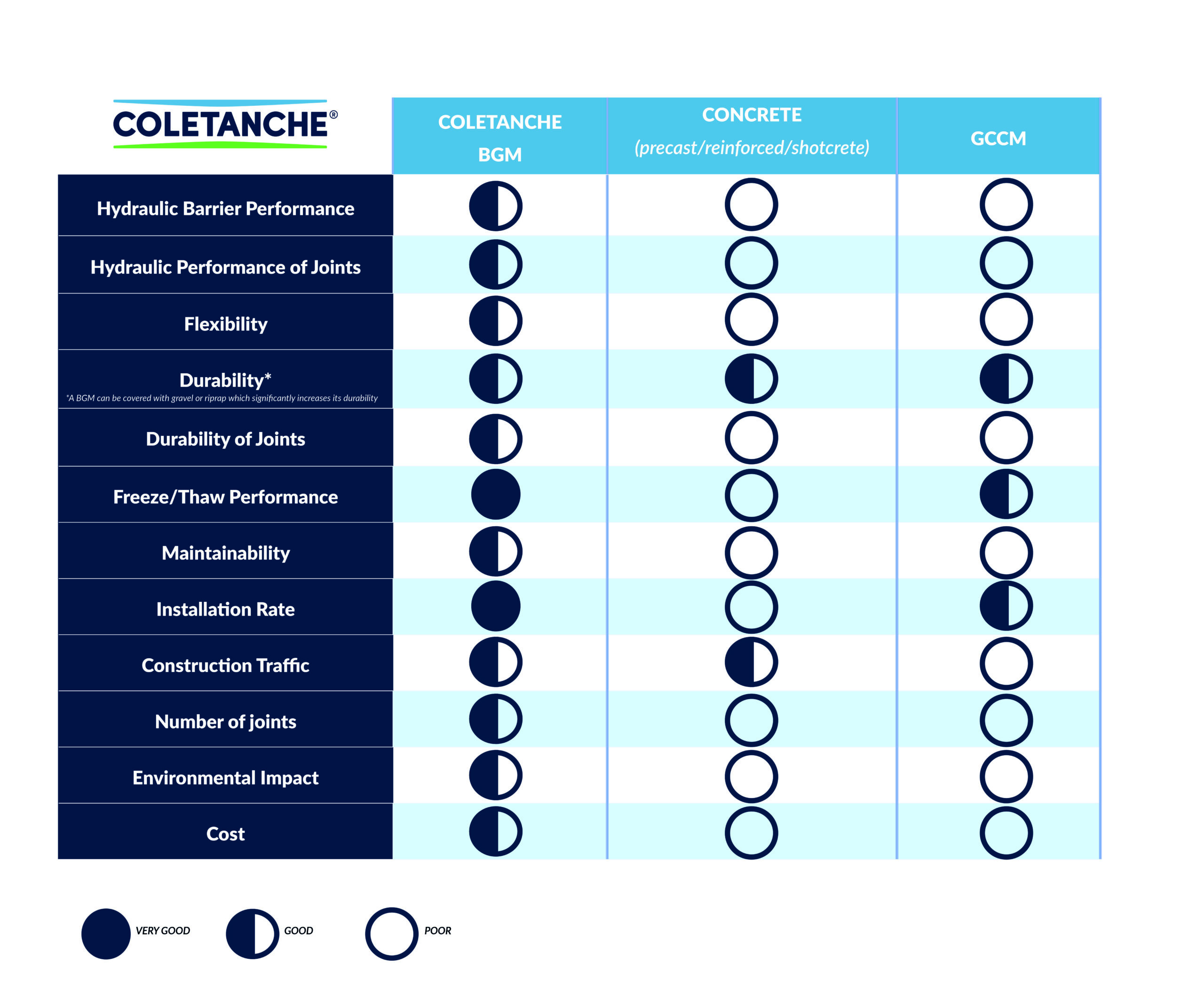
The following table summarizes the comparative performance of Coletanche® BGM against traditional concrete and GCCM canal lining systems.
1. Superior Hydraulic Performance
Hydraulic Barrier Performance
Coletanche® Bituminous Geomembrane (BGM) is a true geomembrane with an extremely low hydraulic conductivity of 6×10⁻¹⁴ m/s, combining watertightness with flexibility and elongation capacity.
Concrete, even when uncracked, is several orders of magnitude more permeable due to its porosity, and over time, rigid concrete inevitably cracks — increasing permeability.
GCCM liners offer greater flexibility than concrete and faster installation, but their permeability remains similar to concrete unless combined with an additional welded geomembrane layer.Hydraulic Performance of Joints and Seams
The seams of Coletanche® BGM are torch-welded, achieving the same hydraulic performance as the membrane itself.
This ensures seamless waterproofing, flexibility, and elongation capacity across the entire system.
In comparison, concrete structures require frequent construction and expansion joints for curing and thermal movement.
These joints often rely on mastic fillers, which increase the need for maintenance and reduce hydraulic reliability.
GCCM systems use mechanical fasteners and adhesives, which lack flexibility and introduce potential leakage points.💧 In short: Coletanche® ensures watertight continuity — no cracks, no weak points.
2. Flexibility, Durability and Resistance
Flexibility
Flexibility is crucial for hydraulic and erosion control applications.
Coletanche® adapts perfectly to surface irregularities and prevents “bridging” or “trampolining,” where rigid materials are suspended over voids under stress.
As flows develop, these voids enlarge and accelerate structural degradation.
Rigid materials like concrete eventually crack, increasing leakage and maintenance needs.
While GCCMs are more flexible than concrete, Coletanche® remains in an entirely different class of performance.Durability
Concrete has excellent compressive strength and durability, particularly for impact resistance.
GCCMs offer similar strength with added flexibility, but Coletanche® levels the field thanks to its non-rigid composition and adaptability.
When required, its durability can be easily enhanced with a gravel or riprap cover, providing additional impact resistance at low cost.🛠️ A Coletanche® BGM can be covered with gravel or riprap to significantly increase its durability.
Durability of Joints and Seams
In rigid materials, joints act as stress concentration points that require careful attention.
Concrete joints filled with mastic depend on the mastic’s longevity and regular maintenance.
GCCM joints fixed with screws and adhesives also depend on the long-term compatibility of those materials.
In contrast, Coletanche® welds can be inspected and tested using destructive, non-destructive, or electrical leak detection methods, ensuring complete control and reliability.Freeze/Thaw Performance
Thermal cycling is one of the most damaging mechanisms for concrete canal structures, especially in cold climates.
Coletanche® BGM maintains its flexibility and performance even at –30°C, while concrete surfaces are prone to cracking and spalling.
GCCMs perform better than concrete but remain less resilient than BGM membranes.⚙️ In short: Coletanche® withstands extreme climates — from desert heat to freezing winters — with no loss of performance.
3. Installation, Maintenance and Logistics
Maintainability
Concrete is heavy and difficult to repair once cured.
GCCM surfaces, though lighter, are also permanent after hydration.
Exposed Coletanche® membranes can be monitored and repaired easily using the same torch welding process as during installation — a simple, repeatable solution.
Installation Rate
Concrete installation involves formwork, curing, truck access, and weather dependency, all of which slow progress.
A BGM roll (5.1 m wide) with welded seams enables much faster installation, even in light rain or cold weather.
While GCCMs improve speed compared to concrete, Coletanche® remains the fastest solution among the three.
🚧 In short: Coletanche® installs significantly faster than concrete — without curing delays or heavy logistics.
Construction Traffic and Joints
Concrete becomes trafficable only after a 7-day cure (28 days for full strength).
GCCMs are generally non-trafficable once hydrated.
Coletanche® can be driven over by rubber-tired vehicles during installation, and with an asphalt or gravel protection layer, it can accommodate light maintenance traffic.
Its large roll width (5.1 m) also means fewer joints — minimizing potential leak paths and simplifying construction sequencing.
4. Environmental and Economic Impact
Environmental Impact
Coletanche® BGM generates no CO₂ emissions during installation since it requires no curing process.
Its lower mass per m² reduces transportation loads, minimizing tire wear, road impacts, and overall emissions.
This makes it one of the most sustainable canal lining options available for large-scale hydraulic projects.
Cost Efficiency
Although costs depend on local conditions, BGM systems consistently offer lower overall costs — both in materials and installation — compared to concrete or GCCM.
Combined with faster installation and reduced maintenance, the total lifecycle cost is significantly reduced.
🌱 In short: Coletanche® combines sustainability and economy — reducing both emissions and project costs.
Conclusion
With over 40 years of proven global performance, Coletanche® Bituminous Geomembrane stands as the benchmark for modern canal lining systems.
Its watertightness, flexibility, durability, ease of installation, and environmental advantages make it a superior alternative to traditional rigid systems.
Coletanche® — Engineered for Performance. Trusted Worldwide.